


The challenge of low wages for child care workers in Michigan
Child care workers in Michigan, including passionate educators like Carla Brown, face low wages and limited benefits despite their crucial role in child development.
Shondra Perry was trying out her third child care, praying she could find a place where her 3-year-old daughter Taylor would be shown love. She’d taken Taylor, who regularly had intense tantrums both in child care settings and at home, out of the first child care center after her daughter’s hair was cut without explanation. Her second provider took Taylor in for three days before telling Perry she couldn’t stay due to behavioral issues.
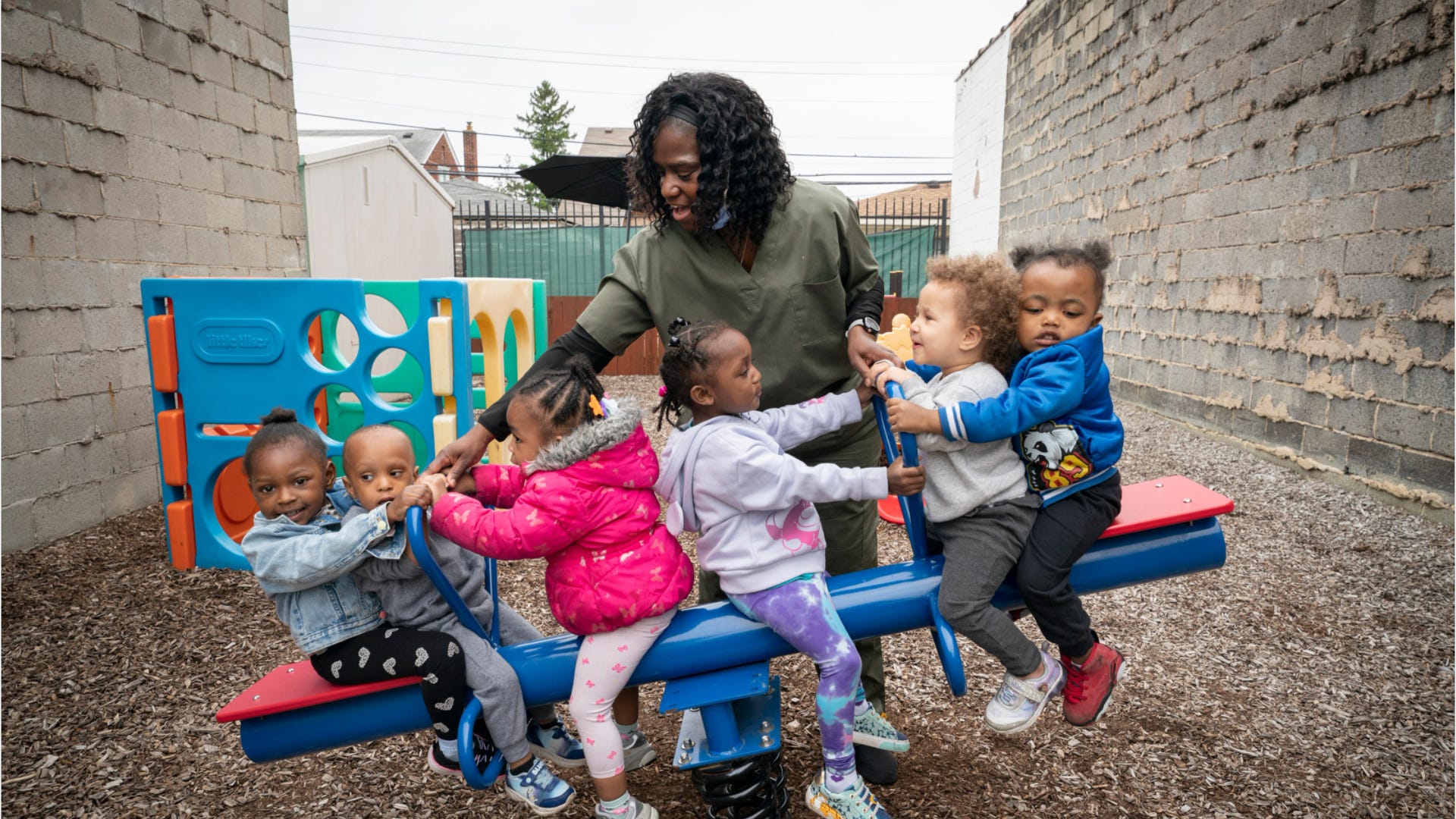
Then, Perry placed Taylor at Carmen Martin’s home-based Detroit child care, Carmen’s Little Angels. Taylor continued having tantrums, but this time, there was a plan.
Martin and Katie Wisniewski, the state-funded mental health consultants who came regularly to Martin’s child care to help her figure out how to best care for kids like Taylor, approached Perry with resources for where and how Perry could get her daughter evaluated and options for therapy after diagnosis.
Taylor was diagnosed with autism and has been in therapy since June 2025.
“Between ABA therapy and Ms. Carmen and me, she’s 98% there now,” said Perry about her daughter, who was able to stay in Martin’s child care after starting therapy that has helped her learn new ways to communicate her needs.
The program that helped Taylor stay in care is called the Infant and Early Childhood Mental Health Consultation program. It’s the only statewide program of its kind that connects child care providers with mental health consultants who come to child care sites, working directly with providers and teachers to troubleshoot solutions for kids with challenging behavior, ranging from temporary issues to longer term developmental delays that need outside therapy.
“It helps teachers develop a strategy for supporting a child,” said Madeline Elliot, policy and programs associate at Michigan’s Children. “It takes the burden off the teacher and staves off burn out.” Teacher burn out is a key concern in an industry already facing high turnover as a result of low pay and lacking benefits.
Providers who’ve participated say the program has become essential in their already often under-resourced sites because consultants provide the expertise to properly address behavioral issues their staff doesn’t have the tools to remedy otherwise.
This helps prevent child care expulsions. Michigan doesn’t regularly track early childhood data outside of its universal Pre-K, or GSRP, and Head Start programs, so child care expulsion and suspension data is not available, but federal data show that child care expulsion rates are over three times that of K-12 rates.
“It literally is a life line,” said Maria Robertson, program director at Little Dreamers Early Learning Center in Lansing which has used the program since 2022. “Providers come into the industry with a heart for children and the industry can feel really lonely when you don’t have the resources you need to do the job you want to do.”
But the program is at risk. Advocates first raised alarms earlier this year, when Gov. Gretchen Whitmer’s budget cut funding for the program in half. With the House and Senate budgets billions of dollars apart and negotiations still ongoing before the new fiscal year starts Oct. 1, it’s unclear where funding for the program will ultimately land. Those who have used it are hoping it stays, fully funded.
MiLEAP, the state agency overseeing early education initiatives which funds the Infant and Early Childhood Mental Health Consultation program did not reply to questions about why funding cuts to this program were on the table.
Gillian Ogilvie, a licensed professional counselor who works as the early childhood mental health coordinator for Michigan’s Department of Health and Human Services and oversees the consultation program, said that while DHHS has found funding to make up the $1.5 million cut from MiLEAP’s $3 million budget in the case it does pass, the funding cut would still be “devastating” and a big blow that “goes against information we’re receiving day to day around how important this service is for kids, families and child care providers.”
Early childhood advocates had hoped the state budget would increase, or at the very least maintain, funding for the program, to “meet the moment where child care programs are seeing more kids with behavioral challenges and special needs than they’ve ever seen before,” said Elliot.
Early childhood mental health services needed ‘now more than ever’
Though the research is somewhat mixed, many studies on the impact of the pandemic on young children have shown evidence of an increase in “externalizing behaviors, especially in preschool-aged children” said Jamie Lawler clinical and developmental psychologist at Eastern Michigan University, with expertise in early adversity, socio-emotional development and self-regulation.
“Things like acting out, tantrums, aggression, not following instruction, those type of problems,” Lawler said.
This has translated into stress and overwhelm for child care providers, who, along with parents, are on the front lines of caring for and educating this population of kids under 5-years-old.
Lawler said the majority of evidence shows that this increase in challenging behavior is due to stressors that increased during the pandemic – parents lost jobs, family members lost loved ones, kids spent more time inside and on screens – and resulted in impacts like kids “not having opportunity for as much socialization and not getting enough practice resolving conflicts with peers,” she said.
Lawler said that at this point, she’d caution the impulse to see these stressors as fleeting pandemic outliers, since many other stressors have increased for families and kids over the last couple years that “can’t entirely be attributed to the pandemic” and are ongoing, like the skyrocketing cost of child care, she said.
Being able to build secure relationships with caregivers and express a full range of emotions is the basis of mental health for babies and young children, which is often misunderstood, Ogilvie said.
“It’s just like gross motor skill development, walking and running and hopping and crawling, that all build on each other,” she said. “It’s the same for social and emotional skills.”
It’s these social and emotional skills that mental health consultants specialize in helping providers and teachers build in their kids, said Elliot. Even without added pandemic stressors, kids act out in ways that can be challenging but developmentally appropriate, like biting, for example, which can be a mode of communicating anger or frustration when language skills aren’t yet fully developed.
Infant and early childhood mental health consultants, who are masters-level mental health professionals, are experts at “seeing the world through [kids’] eyes” to figure out what a child’s behavior is communicating and help teachers and providers develop a strategy for supporting that child, Elliot said.
Consultants also help providers navigate conversations with parents and resources for testing and therapy in cases like Taylor’s, when it is clear that behaviors are not the result of temporary trauma that can be solely overcome within the child care setting.
“Now more than ever we definitely need early childhood mental health consultation programs,” said Lawler, who also wants people to recognize that early educators and child care providers went through similar stressors during the pandemic and need support, too, as they confront the impacts of compounded stress on kids and families in their daily job.
“That should be taken into account, too,” she said.
Mental health consultants part of ‘the village’
As a business owner, Jacqueline Taylor, who started out in her home and now owns Little Dreamers Early Learning Center, said child care providers are often forced to make impossible decisions when it comes to caring for children with behavioral challenges.
“Do I want to preserve my teacher, because if the teacher gets burned out I will lose them, or do I fight for this child?” she said.
Having a mental health consultant has made it so she hasn’t had to choose between teacher or child and family wellbeing.
In the three years that they’ve worked together, Taylor said her consultant has become an essential part of her child care site and has prevented challenging moments from eventually escalating into expulsion. Taylor has a current case with a child who was expelled from his previous child care, but was able to stay at Little Dreamers with their consultant’s support. “She helps us get through the rough transitional time – now it’s totally fine, he’s settled into the classroom,” she said.
Pairing her and her staff’s expertise in early childhood development with their consultant’s expertise in human development and psychology allowed the Little Dreamers team to experiment with different solutions to successfully shepherd kids through difficult times.
“Together we’re able to work together to speak the same language to make sure each child in our program can get the specific care they need,” Taylor said.
This is a major part of the benefit of the program: bringing different expertise together to meet a child’s needs. “When you want to run a high-quality program, it really does take that village,” she said.
Taylor says she’s passionate about keeping children in care, especially as the burden of expulsion falls disproportionately on Black boys, who make up 9% of public preschool enrollment but 20% of expulsions, according to recent federal data.
Martin, who owns Carmen’s Little Angels, said that Wisniewski, her mental health consultant, helps her successfully get through to parents who she said often wouldn’t take her concerns about a child’s behavior seriously otherwise.
Before she started using the consultation program, Martin said she had three kids at once who she believed likely had special needs. She remembers it as a difficult time when daily tantrums and meltdowns disrupted learning and she had to change her curriculum and classroom, removing toys to limit stimulation and engaging with kids near constantly to prevent further breakdowns.
With Wisniewski by her side, Martin said she felt confident not only in directing parents to the right resources they could use to get their kids clinically evaluated for special needs, but also in getting parents on board with this reality in the first place. “Some are in denial, some understand, some take it personally, to where they think you’re challenging their parenting,” Martin said.
The resources Wisniewski was able to provide and her presence in conversations with parents lent Martin legitimacy and helped “push the envelope harder,” said Martin, so that parents truly understood that getting their kids connected to testing and therapy was necessary for their child being able to stay in her care, which was Martin’s main concern.
Perry was one of those parents, and said the conversation with Martin and Wisniewski about her daughter Taylor was both hard to hear but also a relief, and ultimately transformational because they gave her a roadmap of what to do, whereas at her previous child cares, “they didn’t give me any information.”
All three of Martin’s kids with special needs have been able to stay in Martin’s child care after receiving IEPs and outside therapy.
Martin said Wisniewski has come to feel like a partner, whose help extends beyond the classroom. Wisniewski attends parent meetings to educate them on what social emotional learning means and gives them techniques they can use at home with kids. Martin said it feels good to “have my parents know they are really being thought of, knowing their children are in good hands.”
An uncertain future, uneasy child care providers
Providers and advocates say the Infant and Early Childhood Consultation program serves as the only state-funded resource for addressing early childhood mental health challenges at child care sites, in a landscape with few other options. While GSRP and federally-funded Head Start classrooms both have some form of mental health specialists available for additional support, GSRP is limited only to pre-K aged kids while Head Start is limited to income-eligible families.
There are some additional options for child care providers in need of help for their kids with challenging behaviors, depending on where in the state they’re located. PEDALS Michigan, for example, operates a free, year-long social and emotional mentorship program that connects coaches with infant and toddler child care providers across Wayne, Oakland, Washtenaw, and Macomb counties. The Ralph C. Wilson-funded program has been so popular that it’s currently at capacity with a wait list of over 20 classrooms waiting for a coach.
Also, because early childhood mental health is championed across Michigan, said Ogilvie, “there are pockets across the state where folks have gotten philanthropy, grants, millages to support this work locally,” she said. But in some counties without these local resources, the state’s mental health consultation program is the only support service available to providers, said Elliot.
The consultation program has 30 consultants across 42 Michigan counties, which have been prioritized for need based on risk factors like how many kids are on the state’s child care subsidy or the rates of child protective service calls in a county. The ultimate goal is to get program funding up to $6 million, which would allow for the program’s expansion into every county, said Ogilvie.
As providers continue singing its praises, Ogilvie said they’re trying to get the program out to areas they cannot reach in person through a virtual consultation program MDHHS will be piloting in 2026. As the program’s future funding remains uncertain, Ogilvie said the virtual option might become a future necessity to get information and support out to more providers on a shoestring budget.
Taylor and Robertson both felt the potential cuts to the program were concerning.
“Investing in infant mental health consultation is not an option, it’s not a bonus, it’s a necessity” said Robertson. “It’s a lifeline to the complete ecosystem needed to ensure all children receive access to high quality care.”
link